Thursday, October 26, 2017

Week 9- Using Hootsuite

Last week, I discussed the social networking application, Hootsuite, which allows the user to be able to post and manage multiple social media pages on one easy to use platform. Now, I will quickly run through how you will connect Hootsuite to your social networking sites and how to make your first post.

The first thing you want to do is go to the Hootsuite dashboard by logging into your Hootsuite account. Once there, you will want to click on the “profile picture” icon in the top right corner which will open a drop down menu (Pictured below). In the drop down menu, select manage social networks.

Hootsuite8.PNG

Once selected, Hootsuite will take you to the member page where it will show you the details of your membership and a section that allows you to add a private social network (as pictured below. Your page will not look exactly the same as mine already has my existing networks showing, but once you add social networks they will show in the same way).

Hootsuite2.PNG

To add a private social network, click on the tab that has a green “+” sign and private network. This will take you to a menu screen (pictured below) that will show you all of the social network options you may choose including: Twitter, Facebook, LinkedIn and others. SImply click on the one you’d like to add, put in your profile credentials and accept Hootsuite’s terms and agreements for each page and you will be connected!

Hootsuite1.PNG
The next step is to make a post. Once you are returned to the member page you will want to click on the “Send To” bar above your main credentials and select the networks you would like to post your message to (shown below).

Hootsuite3.PNG

Once the networks are selected, you can make your post. Type the message you want to post to your selected social networks by typing it into the “Compose Message” bar to the right of the “Send To” bar. For this test, I am simply going to put “Testing Hootsuite” (as shown below).

Hootsuite4.PNG

By clicking the “Send Now” button, your post will be published to the social networks that you have selected. You can see my posts below:

Twitter:
Hootsuite5.PNG

Facebook:
Hootsuite6.PNG

LinkedIn:
Hootsuite7.PNG

Now you will be able to successfully use Hootsuite to make a social media post on multiple social networking sites. Good luck and happy networking!



Tuesday, October 24, 2017

Week 8- What Color is Your Parachute Chapter 6

The grind of a job hunt can be a very difficult one. With many of the attempts not going the way that one would hope, it would seem like giving up may be the better option. But giving up should never be an option, when the search gets tough you must keep pushing to get the job that you need and want.


In the book What Color is Your Parachute by Richard Bolles, the author discusses the difficulty of getting a job and how easy it may feel to give up on the job hunt. As Bolles describes the three most important rules for job-hunters, “1. Never Give Up 2. Never give up 3. Never give up” (99). Once you rebuild your confidence and keep driving toward a job, success will come.


Bolles continues the chapter by discussing how successful different job hunting strategies are for people looking for a job. Most of these ideas are not as successful such as looking for employers’ job postings on the Internet, posting or mailing out your resume and answering local newspaper ads which have a success rate between 4% and 30%. Though those are not as successful for job-hunters other strategies discussed such as job clubs, using the Yellow Pages to contact companies and knocking on the door of a company have had success rates 47% and 84%.


The job hunting process may seem hopeless at times and it may seem like you may never get the job you want, but this is only the time you need to push harder. Change your approach to job hunting: use the Yellow Pages, approach companies looking to apply for jobs, use as many resources as possible including friends and family. Never give up, keep pushing and success will find you.  

Sunday, October 22, 2017

Week 8- Hootsuite

With the rising use of social media by companies, it has become more important for these companies not only to have many different social media pages on different sites, but also to keep them uniform to the company’s central idea. The website Hootsuite allows company’s to do just that.


Hootsuite allows a profile user to connect and control multiple social media pages from different social media websites and put it in one platform. This allows the user to be able to make the same post across all their social media pages at the same time and allows them to manage how their company is doing on social media and how the consumers are reacting to the social media posts. This makes it much easier for the company then to have to go through each one of the different websites and making separate posts.


Hootsuite allows both free and paid options which is nice if a company does not have the budget for monthly payments. Hootsuite also allows you to schedule posts at certain times so if there is a sale or a special post a company wants to make for a certain time, Hootsuite can help them with that. Social media may be one of the most significant parts of business in the modern world and Hootsuite is making the task of social media management easier for everyone.

Thursday, October 12, 2017

Week 7- What Color is Your Parachute Chapter 5

Salary negotiation is something that should happen during every interview process and most times should occur after the job has been offered and the job-hunter is willing to accept it. Should is the key word here because, in most cases, job-hunters skip over or ignore this part entirely. This will not make for a successful finish to obtaining a job, at least not as successful as it could be.


In the book What Color is Your Parachute by Richard Bolles, Bolles describes the significance of salary negotiation and also the typical reaction most job-hunters have towards it, “Negotiation. There’s no word that strikes terror into the hearts of most job-hunters or career-changers. Why do we have to negotiate?” Salary negotiation can be a daunting task for anyone, in most cases the job-hunter is just ecstatic to be getting a job, but it is a crucial part to having the most successful job hunting experience.

The most significant part of salary negotiation is to know what number you are looking for with the job as well as understanding what salary the employer is looking to give you. This can be done through some simple research of the field and of the company. Understanding how much the average employee makes in a similar position in a different company can give you a good start of your salary “range”. Also, looking into other employees in the company with similar duties in the company can make your range more accurate for yourself and the employer.


The key of a successful salary negotiation is to understand both what they are looking for and what you are looking for. Another idea is to go into a negotiation not with a salary in mind, but a salary range. This range will allow you to get at least what you’re looking for while also being able to get more.

Just remember at the end of the day if they offered you the job they do want you. If they want to discuss salary then it is up to you to be prepared for that and be able to give them an accurate response, but there is no need to give a solid number. If you have done your research and have a salary range set in your mind, you will be able to find the most success. Just don’t be afraid of the word “negotiation”, it is not as scary as you think.

Week 7- Facebook Insights

Facebook can be seen as one of the most popular social media websites that the Internet can provide. With its high level of popularity and recognition, it is no wonder that more and more companies are creating Facebook pages to further engage their customers. Facebook is very helpful with the layout of their Facebook pages and even provide statistics for the page creators with a thing called Facebook Insights.

Facebook Insights allow the creator of a Facebook page to see the kind of traffic their page is receiving, this includes statistics of views, page likes, reach and page followers. Below is an example of the a Facebook Insights page for a page called JobLife:

Overview.PNG

The Insights page is very user friendly as evidenced by its simple page design and clear labels for the page. It also allows the page creator to see how their page is doing over time in certain areas which allows them to better strategize their online communications. JobLife seems to be having a successful month currently with a boost in both page views and page likes, but may need to increase their reach.

Another helpful tool that Facebook Insights can provide is breaking down the people who view the page into many different categories like age, gender, location or even language. This allows the creator of the page to see how they should organize their posts, who they should target and the best way to do so. Below is how JobLife’s fans are broken down:


The JobLife fans seem to break down in a rather simple way with most of the viewers being between ages 18-34. It also appears that there are a few more women who look at the page than men and most of the views come from South Africa. These statistics could provide the creator a simpler way to connect to their fanbase.

Facebook pages are becoming more crucial to a company’s social media success in recent years. Luckily for new or inexperienced users, Facebook has provided a simple and user-friendly way to understand how to get the most out of their page with Facebook Insights. Once one gets an understanding of Facebook Insights, they will be able to see their page (and in turn their company) gain a bigger following.

Monday, October 9, 2017

Week 6- What Color is Your Parachute Chapter 4

Every job hunter knows how important an interview is to their ability to getting a job. For many, this is the most intimidating part of the job-hunting process and many will stress, prepare and rehearse for the interview with the understanding that this process is the most significant part of them landing a job. Of course the interview carries the most weight when it comes to landing a job, but how a person reacts after the interview is just as significant.


In the book What Color is Your Parachute by Richard Bolles, he talks about the significance of a thank you letter is to employers.


“Every expert on interviewing will tell you two things,” Bolles says, “1. Thank-you notes must be sent after every interview, by every job-hunter and 2. Most job-hunters ignore this advice”


The significance of thank you notes cannot be stressed enough. Although many people are told to take this advice, many do not so this can be the difference between you standing out or just being another face in the crowd. Another positive is that it can sum up the interview and remind those who you interviewed with of what you have to offer.


Besides the fact that the thank you note reminds them of who you are, the interview can also help you reflect that you work well with people and gives you a chance to correct any wrong impressions you made during the interview.


At the end of the day if the interview did not go well or if your interest in the company has waned, the thank you note allows you to wrap up the job hunt with this company. This allows you to still seem presentable without the awkwardness of leaving an interview feeling unfinished.


The significance of the job hunt does not all lie in the interview. Be prepared for the interview and do not let it stress you too much. Just remember to always send that thank you note when you have finished your interview.

Thursday, October 5, 2017

Week 6- Social Monitoring

With the rise of social media, businesses have never had a more direct access to the views of the people. When making social media posts about businesses or people, there are ways for those companies to be able to see what people are saying about them. This process is called Social Monitoring, which is defined by Brandwatch.com as “the act of using a tool to listen to what is being said across the internet; monitoring media not just from traditional publishers, but on millions of social sites too.”


Social monitoring has helped give businesses an advantage on not only knowing what people are saying about their company, but also how they can use this information to adjust their business to best fit the consumer’s wants or needs.With this, a company can know when it is best for them to do certain ad campaigns, adjust their customer service or what times of year the consumers are talking about their company for advertising.


There are many different Social Monitoring websites that companies can use, but I will only discuss the free sites that I used during class, Google Trends and Social Mention. I will use a company that I previously worked for, The Kane County Cougars baseball team, to give you an example of how these sights work.


With Google Trends, it monitors the amount of Google searches are done about the certain topic or company you want to see and puts the “trending” on a 0-100 point scale with 100 being the most times the term has been searched. Looking at the Kane County Cougars trend over the past year, it becomes clear that in the heart of their season, about mid-July, the term has its highest search total. Its lowest search total comes in the middle of their offseason, about mid-November. These trends make sense as the term follows the team’s season, so it may be good for the company to put their best ad campaigns during the turn from low to high searches (beginning of April).


As for Social Mention, it does not monitor all of the most well known social media sites but it does have Twitter, Reddit and Wordpress among others. For the Kane County Cougars, the posts are not very recent, but that is not surprising with their season ending about a month ago. What the website does help you see is the actual post people are making regarding the company which is a helpful tool for a business. It also allows you to see the reaction that people have toward your business by ranking the posts positively, negatively or neutral which is another helpful way to hear what people are saying.

So if you are working for a company and they would like to know how the company is doing on social media, these websites will help you to find what the customers are saying. Social monitoring is definitely an important skill that you should utilize for the future.

Thursday, September 28, 2017

Week 5- LinkedIn: The Online Resume

As many job-hunters today have noticed, many organizations have become more and more digital as technology has grown in society. One of the biggest resources that employers utilize in the modern job search is the social media site LinkedIn. LinkedIn has become the online marketplace for both job-hunters and employers as people can connect with one another on a professional level, much different than other social media sites.

One of the benefits of LinkedIn has is being able to connect people from different organizations on a professional level. If you have worked for an employer and would like to stay connected with people in the field while looking for other opportunities, LinkedIn will allow you to connect with these people. Whether it be by a basic name or company search or sharing the connection information in person, it has not been easier to communicate with people in your job field. As the saying goes, “It is all about who you know” and LinkedIn truly takes that to heart.


Another benefit of Linkedin is the fact that it puts your resume online. This may not be the resume you think of when you hear the word, but it is essentially the same principle. Linkedin allows you to list your job experience, education, skills, awards and memberships and other factors on your profile, making it easy for employers to see what you can bring to the table.

LinkedIn is one of the most beneficial online sites available for people in the professional working world and one that job-hunters should get on. Although I have discussed a lot about what LinkedIn is, I have merely scratched the surface and there is much more that job-hunters should look into. I highly recommend that job-hunters make an account and try it out for themselves, it can only help you in your journey for a new job.

Week 5- What Color is Your Parachute Chapter 3


The hunt for jobs seems like a daunting task for most people looking for new opportunities in the world. In most cases, it seems like it is the employer against the applicants, trying their best to eliminate anyone that doesn’t fit the company as quickly and easy as possible. Although it may feel that way, the applicants are not powerless and actually have a lot of power in the job hunting process.


In the book What Color is Your Parachute by Richard Bolles, Bolles discusses how an interview is not just the employer choosing candidates by asking questions, but also an opportunity for the applicant to ask the employer questions to see if it is the right fit for them.

“The job-hunt is a conversation--a two-way conversation--wherein your opinion matters as much as the employer’s,” writes Bolles, “That has always been true. Always will be.”

The interview or even the job-hunting process should never be one person against the world. Applicants should conduct research, ask questions, look for assistance and do as much as they can before they start applying to the job, to be assured that the position is a good fit.


Once that is completed and they are granted an interview, do not allow the employer to control the interview, they want to hear from you. Discuss your best skills, things that they will not be able to see on a resume, and do not be afraid to ask questions during the interview. Once you understand that you have control in the process, the job hunt will become much easier.  

Saturday, September 23, 2017

Week 4- Labeling and Organizing Your Blog

Blogs can be tricky. If you are an avid blogger with a lot of followers, you may discuss hundreds of different topics on your blog and could have multiple in one blog alone. If you have a themed blog, sports for example, you may have a blog post about the NFL one week, but then discuss the NBA the next. What if your readers don’t care about the NFL and want to only read the NBA posts? This is where organizing your blog or labeling the posts will help you the most.

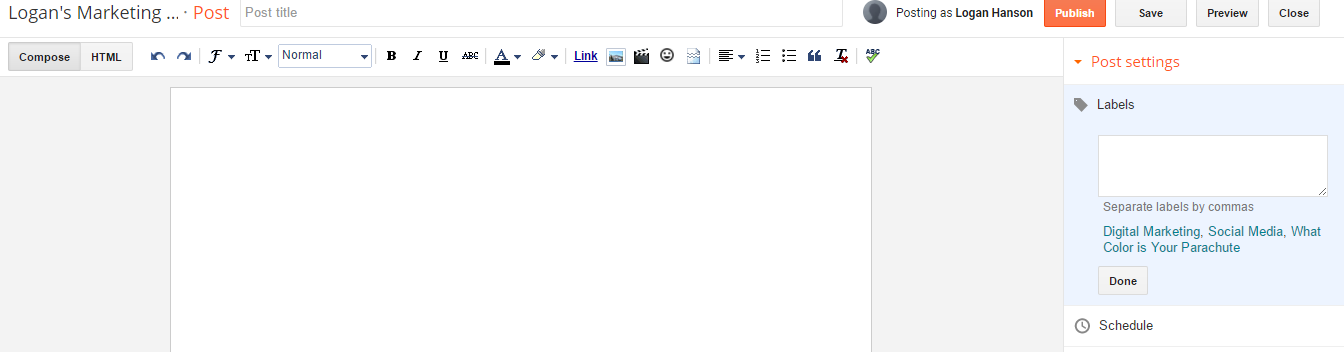
Labels are a simple way to organize your blog post. For Blogger (that is the website I currently use for this blog), it is very simple to add your labels. Once you finish a post, go to the right side of the screen and click “Labels” and it will open up a typing screen. Simply type in the label you would like your post to have, going back to the sports blog you could either label it “NFL” or “NBA” and you could give it multiple labels and just simply separate them by commas.

Labels snip.PNG

Above you can see how Blogger allows you to label your blog (to the right side of the screen).

Now you need to your readers to be able to see which labels you have in your blog, so they can organize by the posts they want to read. On Blogger, select “Layout” and click “Add a Gadget”. This will give you multiple “gadgets” you can select to place on your blog, click “Labels” then click “Save”. Now your labels will be present on the front page of your blog for all of your readers to select.


Above is an example of the front page of your Blogger blog. (Note the labels to the right) 

Organization of your blog will not only make it easier for you, but your readers. So keep blogging and label up!

Image result for ed edd n eddy labels

Thursday, September 21, 2017

Week 4- What Color is Your Parachute Chapter 2

A resume may be the one of the most easily recognized part of job-hunting. Many people have a resume or, at the very least, have heard of or seen a resume. Although a resume is one of the most well-known job hunting in the modern world, employers have used other resources to determine if you are the candidate they are looking for.

One of the most significant tools employers use is the basic Google search. Many college students have been told, “Google yourself, just to see what is out there.” In most cases, a Google search is the simplest way to find out the most about who you are and how you present yourself on the Internet. According to the book What Color is Your Parachute by Richard Bolles, the Google search has become so important to job-hunting that, “68% of the time...an employer will offer someone a job because they liked what Google turned up about them.” Check yourself on Google, see if everything out there is presentable and how you want to be shown to employers. If it is not to your liking, fix it by changing your social media profiles (don’t destroy your personality, just make yourself more professional/presentable) and take that next step to getting a job.

family-guy-gif-google-yourself.gif

Another key tool that some employers are looking for is a portfolio. A portfolio is significant for employers looking to see what you have done in the past, in my field of communications this is key as most employers look to see either published work or your effectiveness of multiple forms of communications. The benefits of a portfolio for a person who is applying for a job is you get to again present yourself how you want to. If you have written a published article or research paper, show employers how and why it got published. If you write a blog (like this one), it may be the difference between getting a job and not. My old blog, Left N’ Right, helped my co-author land an internship his sophomore year because he had experience blogging. Portfolios help employers not only see the skill you have in the field, but also gain more information about who you are and how you operate and the more they know about you, the better your odds are.


Although a resume is significant and does help to get your foot in the door, there are other ways that will help better your chances. Check your “Google resume”, fix it up and make it presentable. Create a portfolio of your achievements in the field so the employer can physically see the successes you have had in the field. Resumes may get the job-hunting spotlight, but they are certainly not the only way you can land a job.

Thursday, September 14, 2017

Week 3- My First Attempt at a Facebook Page

This week in our class we learned how to setup a Facebook page and how to get people to follow and like our pages. The blog I created, Logan Hanson’s Digital Marketing, is right now the very basic that a Facebook page can be, but I still recommend that you all follow or like the page. Although I am rather new to Facebook pages, this was not the first page that I created.


Way back when I was younger and had a little more time on my hands, about two years ago, my friend and I decided we were going to jump start our college experience by creating our own sports blog, Left N’ Right. This included our own webpage (using Weebly.com, but now I am a fan of blogger), our own Gmail account, Twitter page and of course a Facebook page. The excitement of having people read our opinions and comment on our posts pushed us to a strong start, but the inexperience of social media marketing made it difficult to remain dedicated.


Left N Right.JPG


This is the Facebook page of my first co-authored blog, Left N’ Right. As my friend and I soon learned, our inexperience of social media marketing would be our downfall.


Most of our issues stemmed from lack of time and an overall lack of perseverance. Both being young college students striving for degrees and future jobs in the workforce made our commitment to a “fun hobby” difficult when put up against studying for exams and finishing homework. The other problem was that it felt like we were doing it all for nothing. After an initial growth of followers from our friends and family, the follows stopped coming, the viewership went down and with little time to create new blogs or posts to social media, it seemed that stopping was the easier and most viable option since not many people were reading anyway.

Although the first blog and website did not go the way that either of us wanted it to go, it was a learning experience and drove me to where I am today. Without that struggle, I may not be taking this Social Media Marketing class and learning how my next blog (this blog) can be a successful one. It is because of this that I have no regrets and, maybe some day, Left N’ Right will rise from the dead and get the attention and help it deserves.

Wednesday, September 13, 2017

Week 3- What Color is Your Parachute Chapter 1

Job-hunting, also known as the most dangerous game for most first time job-seekers or those who have not had to job hunt for some time. To many finding a job seems like the never ending struggle between not having the right skills or doing something wrong. In reality, it's not so much about what skills you do not have, but rather the way you present the skills that you do have.  


In the book What Color is Your Parachute by Richard Bolles, Bolles describes the many ways that the modern job hunt has changed from years past. In the first chapter, Bolles discusses the actual difference between us everyday job hunter and those who will choose our fate, the employers. As Bolles puts it, “The ways you hunt for each other are not just different; they are exactly opposite” (Bolles, 13). So how does one avoid this inevitable fight between one ideology and the other, change your approach.


Many of us new job seekers (yes, I am talking to you college students) approach an interview in the same fashion. Typically the same or similar business attire, a good smile, a nicely printed resume and the cookie-cutter introduction that you’ve rehearsed either to your best friend or bathroom mirror a thousand times. Within this lies the problem, how is one supposed to take that next step to the “big” job if one continually pitches themselves the exact same way to different people looking for different things? Luckily, the solution is just as simple.


Present yourself differently, every time. Have different resumes for different job, have different introductions and answers, and approach each interview as a new opportunity to present yourself in a way nobody has seen. This will help you avoid the cookie-cutter routine that most employers get from the people in our age group and you will gain confidence with each interview you do as you are not pressured by wondering if the company will like your “elevator pitch”.


Focus the interview on the skills you do have and make them shine. They are interviewing you so it is in your best interest to show them your best. Most of all, do not be nervous, you are just pitching yourself and that is it. So go out, apply for jobs, be yourself and get a job!